alyaza

joined 3 years ago
MODERATOR OF
 

When Ceyenne Doroshow first began raising money to buy a building that would provide safe housing for transgender women in New York City, she recalls, “people were coming out of the woodwork trying to offer us the equivalent of crack buildings, in bad neighborhoods, with horrible policing,” just because those buildings were cheaper. But Doroshow found this unacceptable. Her organization, GLITS Inc. (Gays and Lesbians Living in Transgender Society), primarily serves Black trans women. Doroshow says after facing so much harassment and discrimination in the rest of their lives, they deserve a chance to live in stable housing in a peaceful neighborhood.

Like many of the women she works with, Doroshow has spent time homeless. “Our families just may not be that nice behind the velvet rope,” she observes. This can lead to so much housing insecurity that even when they’re housed, program participants’ anxiety stays high: “As soon as they got into [an] apartment, they were already mentally processing for the next round of . . . moving on again,” she says. That’s one of the reasons GLITS emphasizes supports and leadership development along with housing.

Doroshow held on to her dream. With money raised during Pride Month 2020, GLITS bought a 12-unit apartment building in a quiet Queens neighborhood, now known as GLITS 1 South. The residents are all part of the GLITS Leadership Academy, a program that helps each participant with their health, education, and leadership development goals. The building includes its own classroom and study space.


Janetta Johnson is CEO of the TGIJP, or Transgender, Gender Variant, Intersex Justice Project. For 20 years, TGIJP has been working for justice for transgender and gender nonconforming people inside and outside of incarceration, through leadership development, reentry services, name change clinics, advocacy, and recently a wellness program.

TGIJP purchased a building in San Francisco’s Tenderloin neighborhood in 2023, creating a hub for organizing and supportive services in the Bay. The neighborhood is the location of the 1966 Compton’s Cafeteria uprising, led by young TGNC (transgender and gender non-conforming) people and drag queens against raids and overpolicing of LGBTQ+ communities. “Black trans people deserve ownership, and I’m not talking about being capitalistic,” Johnson says in the report Duranti-Martínez co-authored for LISC, “We Take Care of Each Other”: The Power and Promise of TLGBQIA+-owned spaces. “It’s important for people to have safe cultural spaces. It’s important for people to have ownership so that they can believe in themselves and their abilities.”

While TGIJP doesn’t manage housing directly, it does help its clients access housing using city resources. It’s a struggle. “Our community is the last to be housed,” says Johnson. The organization has considered owning its own housing in the future, but under the current administration, it is not currently looking to take on new projects.


There’s a running joke online that gay people just make better coffee. It usually boils down to someone crossing their fingers that their barista has they/them pronouns, so their cold brew is actually drinkable. “I’ve definitely heard the joke and there’s a lot of truth to it,” says Kent Collins, owner of the Flying M Coffeehouse in Boise, Idaho. “Queer people are a huge part of coffeehouse culture—they always have been.”

At the intersection of Halsey Street and Malcolm X Boulevard in Bedford-Stuyvesant, Brooklyn, passersby are greeted by a hot pink sign welcoming them into Soft Butch, a trans-owned café. Antæus Mathieu, a co-owner, says that “ on the surface, it’s a funny, cute meme about how all your baristas are gay,” but there’s more to be said about job accessibility within the coffee industry. “It’s one of those skilled jobs that are both accessible to queer people and people who are [otherwise] marginalized because you can start on so many different levels.”

Whether or not you buy into the playful stereotype, what’s certainly true is that the LGBTQ2S+ community has long-standing ties to the coffee industry. Coffee and tea have long been a way of creating community at a low-cost buy-in, according to Dr. Alex Ketchum, an associate professor at the Institute for Gender, Sexuality, and Feminist Studies at McGill University in Montreal who’s also the author of Ingredients for Revolution: A History of American Feminist Restaurants, Cafes, and Coffeehouses—which, she says, were primarily run by lesbians and queer women. She points to the “women’s music musicians”—a code word for lesbian artists at the time—who would work at Brick Hut Cafe, which was a lesbian-feminist establishment founded in the seventies in Berkeley, California, during off time between touring or recording. “ Not that all queer people are creative—I don’t want to generalize us—but there is this kind of tie [between the] artist community and cafés,” Ketchum explains.


Even as the number of youths who identify as LGBTQ rises, so has the number of state-level bills seeking to curtail their rights, a new analysis finds.

The number of bills aimed at rolling back or prohibiting in-school protections and health care access has tripled from 77 in 2020 to some 300 a year in 2023, 2024 and 2025, according to the Movement Advancement Project.

The drumbeat of legislation, report the researchers, has taken a steep toll on the mental health of the students in the crosshairs — regardless of where they live. When the dramatic escalation in legislation started in 2023, 90% of LGBTQ people ages 13 to 24 said politics had a negative impact on their well-being — up from 71% in 2022.

Policies enabling in-school support are particularly important to LGBTQ youth. Slightly more than half say they are accepted by peers or teachers at school, compared with 40% who are supported at home. The presence of even one supportive educator in a child’s life has long been shown to reduce rates of suicidality, anxiety and depression.

The number of young people impacted has risen sharply in recent years, though estimates vary depending on how data is tabulated. According to a recent Gallup survey, almost 2 million — or 9.5% — of teens ages 13 to 17 now identify as something other than straight or cisgender. That’s nearly twice as many as in 2020.


In the imagination of the far-right, bisexuality is a symptom of the so-called sexual degeneracy of Western women, and functions as a gateway into other “progressive” or “anti-family” beliefs. On forums, in Telegram or Signal channels, private Facebook groups and on Instagram pages, bisexuality is discussed far less frequently than trans people (discussions about trans people are almost incessant in far-right spaces, given the current culture war around trans identity. These discussions feed both into and off of the Trump administration’s attacks on trans rights), but mentions were still present enough to surprise me during my research.

The most common way that bisexuality is mentioned or discussed is as a misogynistic shorthand to indicate that a woman is promiscuous, untrustworthy or degenerate. Bisexual men do not exist in the far-right imagination, and most mentions of bisexuality are bi-misogynistic.

To further this, bisexuality is associated with instability, impermanence and frivolity, which, to the far-right, are weak characteristics that are associated with women. In contrast, men and masculinity are characterized as being stable, strong and unchanging. Bisexuality simply does not fit into this.

A common meme format in online far-right spaces compares “modern/progressive” women to “traditional” women. The modern woman is often depicted as being in a bigger body, with tight-fitting and revealing clothes, brightly coloured dyed hair and body modifications. Around her, there are descriptions of who she is as a person, which usually include things like “owns multiple cats,” “on her fifth abortion,” “thinks casual sex is empowering” and, invariably, she is described as either bisexual or pansexual. Often, there is often mention of this archetype having sex with Black men or having biracial children. Sometimes her sexuality isn’t mentioned at all, but I never saw the progressive archetype being described as straight or a lesbian. She is only ever bi, pan or unlabelled. In contrast, the “traditional” woman is depicted as slender, with long, natural-coloured hair, wearing modest clothing. She is usually described as “loving God,” “being submissive,” “recognizing the sanctity of life” and having white babies. She’s also either described as straight (or sometimes “understanding God’s design for men and women”), or her sexuality is not mentioned, which is intended to suggest that she is “normal” (i.e., straight).

The “progressive” women’s bisexuality is also often coupled with mentions of her having had abortions. In this way, her sexual orientation is used to hammer home how dangerously promiscuous modern women have become. It is implied that without male oversight, women are inherently so sexual that they will not limit themselves to proper sexual propriety—like sleeping with one gender—and will engage in race-mixing and abortion. Her sexual fluidity is used to suggest that women’s sexuality and bodily autonomy need to be controlled by men. The “traditional” woman is not just straight, she is submissive to men— as conservatives think she should be.


It’s not uncommon for transgender people to get a negative reaction from their parents when they come out. But parental support is particularly crucial in China, where trans people need parental consent to undergo gender-affirming surgery and change their legal gender — even as adults. (If their parents are deceased, trans people must prove that to authorities.) These hurdles often make it harder for trans people to obtain care.

Lee, who wanted to pursue the surgery, said he considered the consent requirement an effort to prevent parents from seeking legal or physical retribution against doctors. “They’ll make a scene,” he said of parents who may not support their child’s decision to undergo surgery. “There will be family members taking out knives to kill doctors. It will become a social issue.”

That was one of the reasons Lee didn’t pursue gender-affirming surgery in China. “My mom is conservative,” he said. Though consent forms can be forged, he didn’t want her to go after the doctor who helped him.

In China, the need to obtain parental consent for gender-affirming care forces families to resolve their differences about the procedure ahead of time, dealing with drama or disagreements inside the family. According to Cherry, an LGBTQ+ organization worker, who requested the use of a pseudonym to protect their safety, the requirement exists to avoid parents causing a stir at the hospital.

It is also the product of a Confucian and patriarchal way of organizing society, Cherry said. For instance, police who want to put pressure on young queer activists often visit their parents’ workplaces and out them — so that the target has to deal with the ensuing family drama. “The person is managed through the family so they don’t become a problem in the public domain,” Cherry said.


For most, getting ready for a night out at The Rocky Horror Picture Show might involve a trip to the dollar store for toilet paper, toast and playing cards, or a few last-minute costume and makeup flourishes. For some disabled fans, it also involves a thorough investigation of the venue.

Will theatre staff and audience members be wearing masks? Will the house lights be on, off or dimmed during the show? How many stairs are there between the theatre and the bathrooms? Is there a working elevator? Have the event organizers bought or borrowed a HEPA filter in order to make sure the air is as clean as possible? Will the performance be amplified, or captioned or have live interpretation?

For Keat Welsh, a queer and disabled activist and educator based in Toronto, these were some of the questions on their mind as they got ready to head out to a Deaf shadow cast screening and live performance of Rocky Horror at Buddies in Bad Times Theatre last October, hosted by local arts organization the Disability Collective.

The event “was a really cool mixture of disability and queerness—I was blown away,” recalls Welsh. “Not only was it a very iconic queer culture thing and a Deaf shadow cast, and they put the money into Deaf performers, but it was also a masked event. They had financially accessible tickets, as well as reserved seating for people who needed seats where there were no stairs. The Disability Collective also made little videos showing how to get into Buddies in Bad Times, so you could view what it was like and how to get around if you had never been there.

“As disabled folks, we know that going to any place requires prep work, and they did all this prep work for you, and one hundred percent that made a difference for me being able to be in this space.”


We on the revolutionary left in the United States are inclined to interpret history through icons. Che, Assata, George Jackson, Fred Hampton, Malcolm, Marx: one look at their familiar images and we know what time it is.

But you don’t have to be an icon to be part of history; you don’t have to be in a famous underground cadre, or be martyred by prison or COINTELPRO. You just have to be one person, however “obscure.” You have to stand up for the people you love, to help them live. Then you keep working and fighting. That’s it. Everybody has this potential. And, given history, Black women tend to have it more than most.

Carol Jean Crooks was a Black dyke. Born October 12, 1946, she grew up on the streets of Bedford-Stuyvesant, Brooklyn, and died alone in early 2022. She worked and fought all her life in relative obscurity. Though most of her work wasn’t legal, her fights created a better and fairer world. If you knew her at all, you probably knew her as Crooksie.

In the early 1970s, Crooksie unwittingly shared space with icons-to-be when she became lovers with, and later a longtime friend of, Afeni Shakur, a brilliant and highly publicized member of the Black Panther Party. A few years later, on August 29, 1974, Crooksie became a small part of recorded history—three years after the Attica Prison Revolt—as the catalyst for the August Rebellion at the Bedford Hills Correctional Facility, where incarcerated women took over the institution and held it for hours. The August Rebellion remains one of the most resounding uprisings in the history of US women’s prisons; it generated a precedent-setting class action lawsuit whose ruling continues to safeguard the right of due process for people imprisoned in New York State, as well as nationally. What follows is a small, incomplete glimpse into Crooksie’s life, taken mostly from second- and third-hand sources. She deserves more, but for now…


Queerly Quilled offers a rare third place, away from school or home, for LGBTQ2S+ youth to connect and express themselves freely. Safe spaces for queer and trans people are already scarce and diminishing. But for those too young to get into the bars and nightclubs that have historically served as LGBTQ2S+ safe havens, they are even harder to come by.

Sara Oremland, the teen engagement librarian for the North Vancouver District Public Library, which hosts Queerly Quilled, feels the need for this safe space among the club’s participants, a group she says has grown faster than the library’s other teen groups.

“When the group started getting bigger, they weren’t there for the books. They were there to be together and feel a sense of belonging,” Oremland explains. “I run multiple teen groups, and with [Queerly Quilled], you feel it a lot that there’s just a feeling of belonging and gratitude that they have something like this.”


I spent so much of my life trying to shout my truth loud enough that no one could take it from me. I thought if I didn’t fight for every inch of who I am, the world would snatch it back while I slept. Maybe I wasn’t wrong. Maybe that fight was needed for me. But him? He doesn’t shout. He doesn’t bargain with the world for permission.

He just is.

He knows who he is in a way I never did. And in that calm, he’s teaching me a freedom I never thought possible: the freedom of not needing society’s permission.

Still, I am terrified. I watch laws get drafted by people who’ve never met him, never sat across from him at breakfast while he laughs about Pokémon or asks for more syrup. I watch grown adults spin cruel stories about kids like mine, and I want to roar, raise my fists, stand between him and a world that wants him small, hidden, undone.

He just shrugs. They can’t make me not me, he says.

He’s right. Laws can make his life harder, crueller, less safe, but they can’t strip him of who he is.


As even the most saccharine queer representation comes under attack, and porn bans proliferate across the U.S., some queer people have rightfully sanitized their presence online and IRL; but others—sex party promoters, kink community leaders and educators alike—have refused to shy away from the more explicit aspects of the queer experience.

Despite what pearl-clutching critics of play parties, bathhouses and other sex-inclusive spaces would have you believe, the bacchanalian festivities actually serve important cultural and historical purposes for queer people, dating back more than a century. More complex than simply a space for people to have sex, bathhouses, play parties and sex clubs are places where queer culture is born, connections are made and community is found.

And though the advent of hookup apps have made these physical spaces less necessary, per se, spaces where people can meet in public for sex, or meet to suss out a potential hookup, still serve a necessary purpose.

[–] alyaza@beehaw.org 10 points 10 months ago

the book, if you'd like to pick it up

[–] alyaza@beehaw.org 11 points 11 months ago

we have a big list of them on our resource page; i haven't gone through and pruned recently, but there are a lot of orgs worthy of the time and money on the list

[–] alyaza@beehaw.org 14 points 1 year ago

Gaming culture and sex has a vexed history when it comes to gender, given the industry’s long history of bad assumptions that ‘real’ gamers are straight men, and that building an adult game audience means sexually appealing to straight men. Female characters in adult games are often expected to have sexualised designs, with entitled male gamers complaining about characters like Horizon Zero Dawn’s Aloy or The Last of Us II’s Ellie not being sexy enough; meanwhile, the BBC has reported about female games workers also being affected by a blasé culture around women’s sexualisation, such as graphic, distressing sexual content being thrust upon female games actors without warning. The few semi-famous titillating console games, like the Leisure Suit Larry series or Playboy: The Mansion, don’t exactly seem like they’re interested in feminism.

But understanding sex in video games means understanding it as more than just cheap eye candy for straight guys. Sex is central to how many video games work, including games that don’t technically have any explicit content. Nintendo games present themselves as bastions of childlike, lightly heterosexual wholesomeness – Mario gets his kiss on the cheek from Princess Peach! – but I’ve written about the gay and trans innuendos common throughout the Zelda games, for instance, and how they’re used to both build Link’s androgynous character and to make use of covertly gay and covertly homophobic comedy. Levels of awareness of sex, from basic focuses on satisfying touch to creating sexual tension, are intrinsic to games in various ways, and the games that play with this awareness often find new and interesting ways to tell their stories, and to reflect on why we play games in the first place.

[–] alyaza@beehaw.org 10 points 1 year ago (3 children)

stepping in here to say: you are not making a very good impression in this thread. people are trying in good faith to explain why you are mistaken here—and how even biological sex is better understood as bimodal rather than binary—and you keep going to somewhat eyebrow-raising, contrarian places and not really engaging with their arguments. we are permissive to a degree of ignorance/lack of knowledge/genuine curiosity that might be prickly for some people, but your current conduct in this thread is pushing the line and likely to get you removed from at least this section if you continue.

[–] alyaza@beehaw.org 21 points 2 years ago (2 children)

i don't think "adding race-specific stripes to a pride flag" is a bad thing, is "treating people differently based on skin tone" except in the most cringeworthy, pedantic, I See No Color way possible, or is "racist"—and i think that if you believe these things you probably will not be allowed to partake in discussions like this on our instance after today

[–] alyaza@beehaw.org 20 points 2 years ago* (last edited 2 years ago) (4 children)

So a pride flag that is clearly textbook racist is good and arguing against it and the people that say its better because of the racism is not allowed here

when you call them racist and imply they're segregationist for having their preference, yes, that is not allowed. that's needlessly aggressive and needlessly sectarian—and speaking personally, "having a preference for more stripes on a flag that represent marginalized communities is racist and like segregation" is just such an overstatement of the point (that i otherwise agree with, for the record—i am not a fan of the progress flag) being made that it verges into being unserious.

[–] alyaza@beehaw.org 8 points 2 years ago* (last edited 2 years ago) (2 children)

Otherwise you could claim a crossdresser were trans or people who claimed they were “attack helicopters” would have to be accepted as trans because there would literally be no argument you could make against it.

this just sounds like a skill issue on your part, i'm sorry--this is not an issue if you have a postmodernist understanding of gender, which most trans people (myself included) subscribe to.

at the end of the day when you drill down? there really is not a material difference between the "real" and "fake" genders--gender is entirely socially constructed, and the designations of "male" and "female" that most people fall into are as arbitrary as any xenogender (real or frivolously created by right-wingers). you only "lose" by entertaining frivolous designations if your understanding of gender is already so narrow that you can't conceptually accommodate anything beyond a handful of stock gender identities to begin with.

[–] alyaza@beehaw.org 38 points 2 years ago (2 children)

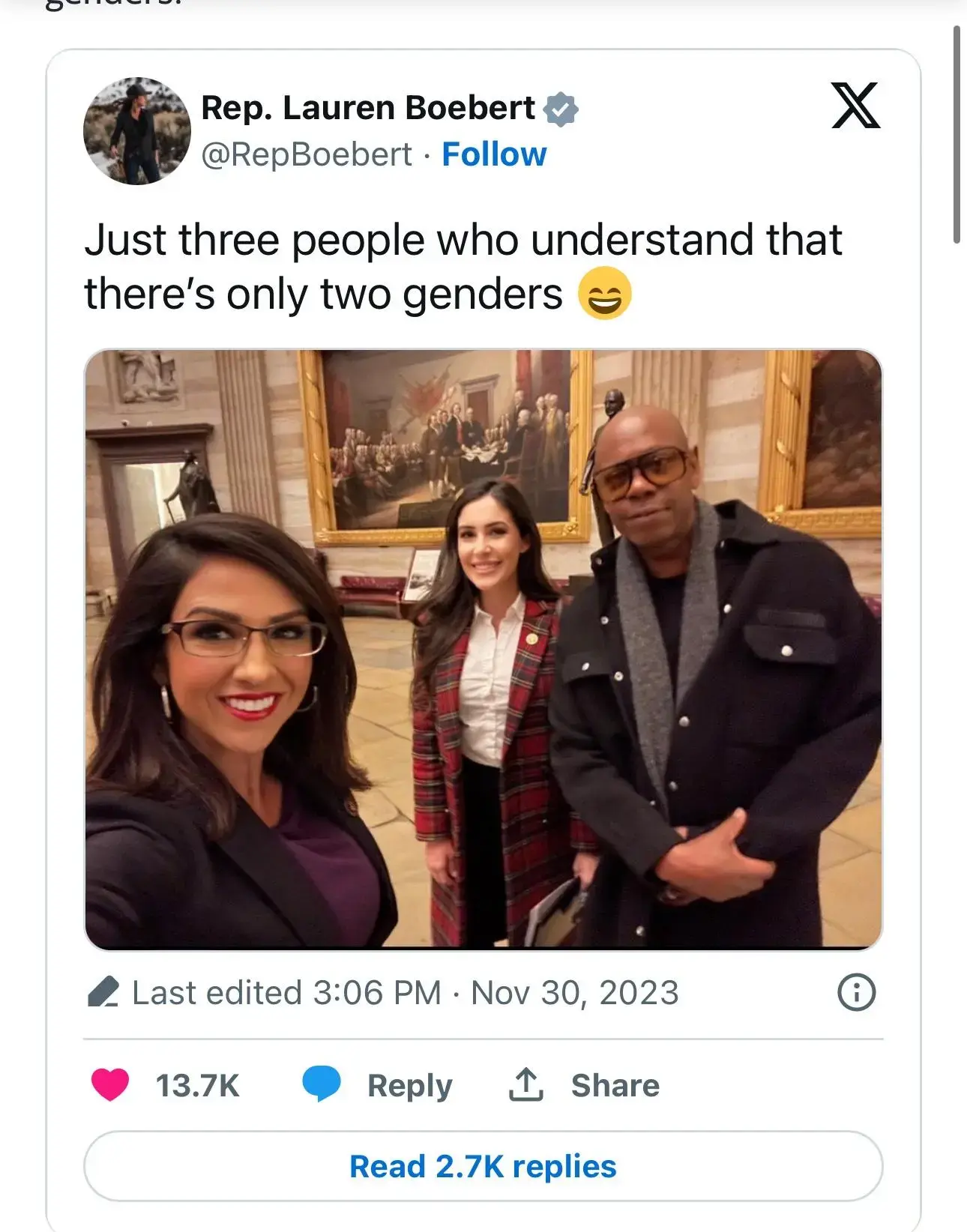
He said during his standup act at Capital One Arena in Washington that he granted the photo request by Boebert for a human moment to bridge the political divide but felt “blindsided” by her, according to a progressive influencers’ blog.

“It’s a shame she tricked me,” Chappelle said, according to Call to Activism. “I had two tickets to ’Beetlejuice’ and I was going to give her one!”

this is, and i mean this respectfully, one of the weakest condemnations imaginable if he's actually got a problem with her doing this. this has zero teeth. it's also literally Lauren Boebert, a person who has made her name being a freakish culture warrior--what did he think she was going to do?

[–] alyaza@beehaw.org 3 points 2 years ago (2 children)

respectfully: why are you throwing a tantrum and screaming at people about this extremely minor deal instead of doing literally anything else

[–] alyaza@beehaw.org 55 points 2 years ago (4 children)

just to add to the plethora of responses: it rather defies belief that he's purely "joking" when, among other things, he's taken photos with anti-trans legislators like Lauren Boebert and let them frame those photos in this manner:
[–] alyaza@beehaw.org 1 points 2 years ago

now that the site is back up: will add, thank you for the suggestion

view more: next ›